We Ran a Ryder Cup Format Event and It Ended in a Tie

So we finally did it. Our league ran a real, honest to goodness Ryder Cup format event this year, out at our home course, and it did not go the way I figured it would. Not the golf, my golf was about what you'd expect from a 25 handicap under pressure. I mean the whole event. It came down to the very last matches of the day, and it ended in a tie. Twenty points to twenty. I've run a lot of league days and I've never seen one land that close.
A few guys in the league had never played match play before, let alone a full Ryder Cup style day, so I want to walk through how we actually set it up, because it's more involved than it looks from the outside, and a couple of things almost went wrong that I think are worth telling on ourselves for.
What a Ryder Cup format actually is
If you've only ever played stroke play, this takes some getting used to. In stroke play you add up every shot for 18 holes and lowest number wins. A Ryder Cup format throws that out entirely. It's team match play, and the only thing that matters is who wins more holes, not who takes fewer strokes.
Every hole gets won, lost, or halved (tied). If you're up by more holes than there are left to play, the match is over early and everybody can just walk in. Win the match, your team gets a point. Halve it, both teams get half a point. That's it. You could shoot the round of your life and still only be worth the same one point as a guy who ground out bogeys all day, as long as he won more holes than he lost.
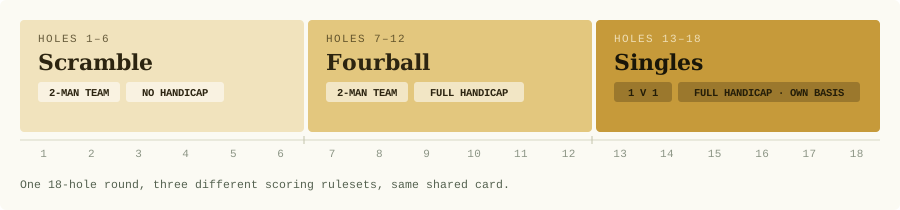
The real Ryder Cup spreads this across three days with different pairings formats. We only had one day, so we squeezed a version of all three formats into one round, six holes at a time.
We split the round into three completely different games
This was the part that took the most thinking through beforehand.
Holes 1 through 6 were a scramble. Two guy teams, everybody hits, you pick the best ball and play from there, over and over. No handicaps in this stretch at all, everybody plays it straight, because the scramble format already sort of levels things out on its own.
Holes 7 through 12 were better ball, same two guy teams, but now each guy plays his own ball the whole hole and you just take the better of the two scores for the team. Handicaps come all the way back in here, full strokes, because now the gap between a stronger and weaker partner actually matters to the outcome.
Then at the turn into 13, the teams split up completely. Each guy in the foursome peels off into his own personal match against one guy from the other side. Full handicap again, but we ran it off each guy's own number rather than just the gap between the two opponents, which is the more traditional way match play strokes usually work. Either way is a legit way to do it, we just picked the one that felt fairer to our group.
Honestly the hardest part wasn't explaining any single piece of that to people. It was keeping straight, on paper, which six holes belonged to which format, especially once guys started asking mid round what their match actually stood at.
The match that had me sweating from the clubhouse
One of our 9:40 groups had a singles match that I heard about roughly ten times before I even saw the card. Two guys, same handicap, so it played out totally straight, no strokes either way.
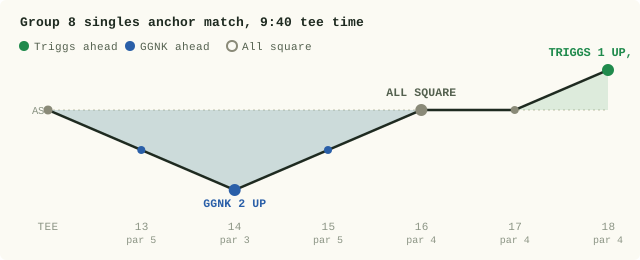
Match status by hole: all square at the tee, GGNK 2 up through 14, level by 16, Triggs wins 1 up on 18.
He went two down after 14. Bogeyed 13, bogeyed 14, and his opponent made pars on both. Two down with four to play is not a great spot. But he won 15 and 16 outright, pars against bogeys, to pull it all the way back to square. Then they both made a mess of 17, doubled it, so that one halved and changed nothing. Whoever won 18 was going to win the whole match. He made his par, his opponent didn't, and he closed it out 1 up.
I could be wrong, but I don't think a guy standing on a tee knowing exactly where his match stands, up or down and by how much, changes how he plays. But it sure changes how he watches the group in front of him.
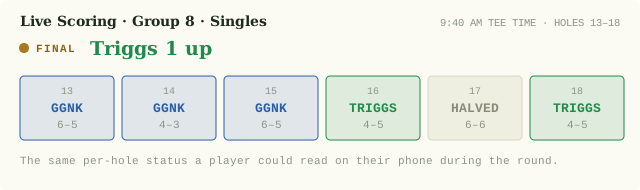
The same hole-by-hole match status a player could read on their phone during the round.
Twenty and twenty
When everything settled, our side took the scramble, the other side took better ball back, and singles split almost dead even. Final score, twenty points each. A full tie.
And this is a small thing but it stuck with me: that same group I just told you about, the one with the two down comeback, their whole foursome's four points ended up split two and two too. Just a little copy of the exact same tie happening inside one group's own scorecard.
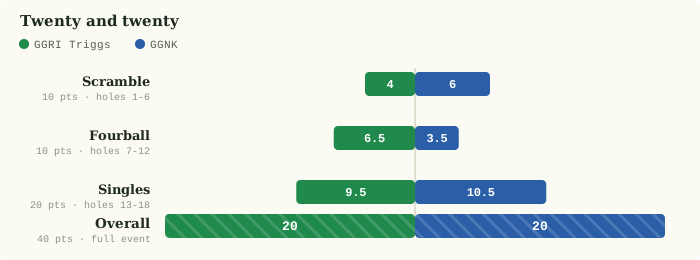
Points by segment: Scramble 4-6, Fourball 6.5-3.5, Singles 9.5-10.5, Overall 20-20.
Two things that almost went sideways
I'd be leaving out the honest version of the day if I didn't mention these.
First, a guy came up to me mid round holding his printed scorecard next to his phone, and the handicap strokes on the two didn't match. Turned out to be a plain coding bug, nobody had touched any settings during the round, the printed card's strokes were just off by one on a few holes. The live scoring on people's phones had it right the whole time, it was only the printed version that was wrong. Annoying to catch mid event, but at least we caught it because a guy was paying close enough attention to notice, and it got fixed that same day.
Second, one of our ten foursomes never got their scores entered on anybody's phone during the round. No idea why, probably just got wrapped up in the golf. Good thing we've always made every group keep a paper backup card too, old habit from before we had anything digital, and I made everybody keep doing it even after we didn't strictly need to. We typed that group's card in by hand after the round and scored it exactly the same as everybody else's. Small reminder that paper backup is still worth the hassle even when you trust the phones.
Worth doing again
It took more setup than a normal league night, no question. But a full 40 guy Ryder Cup format day, three formats on one card, decided by half a point in the last matches, is the kind of thing people are still talking about at the next league night. We're already getting asked when we're doing it again.
For what it's worth, we run our league's scoring through Hold the Green. It's what let us split one round into three scoring formats and still see live match status on everybody's phone as it happened, no clipboard math required. They're taking new leagues into the beta right now, so if you want to try running something like this yourself, go sign up at holdthegreen.golf/beta-signup.
Do you need special software to run a Ryder Cup format event?
Not strictly, plenty of leagues have run match play days with paper cards and a clipboard for years. But once you're splitting one round into different formats with different handicap rules for different sections, doing it by hand gets error prone fast, especially trying to keep a running point total that means something before the whole field is done.
What's the real difference between fourball and foursomes?
Fourball is what we called better ball here, each guy plays his own ball and you take the better score. Foursomes is alternate shot, one ball per team and you take turns hitting it. We used a scramble instead of true foursomes for our first six holes since it's a little friendlier for a mixed handicap group, but foursomes is the traditional Ryder Cup format for that session.
How do handicaps usually work in match play?
The traditional way is "difference in handicaps," where only the higher handicap player gets strokes, and only for the exact gap between the two players, applied to the hardest holes first. Some leagues simplify it so each player just gets their own full personal allowance instead. Both are legitimate, it just needs to be decided ahead of time and applied the same way for everybody.