

Ryder Cup Format Explained: Four-Ball, Foursomes, Singles and How to Run One
Short answer: The Ryder Cup format is team match play between two sides. Players meet in head-to-head matches (four-ball, foursomes or singles), each worth one point, with half a point to each side for a halved match. The side with the most points wins. A league version fits in one day with any even number of players, such as 8, 16 or 40.
Every September (or every other one, if you're counting the real thing), a bunch of guys in my league start saying the same thing: "We should do a Ryder Cup." And then nobody does, because it sounds complicated.
It isn't, really. We finally ran one this fall, our own Triggs vs. North Kingstown Ryder Cup, forty guys, two sides, one day, and it came down to the very last matches and ended in a 20 to 20 tie. It was the most fun I've had running a golf event, period.
So here's the format explained: what a Ryder Cup is, how four-ball, foursomes and singles work, how the points add up, how to handle handicaps, and how to set one up for your own group.
What is the Ryder Cup format?
The Ryder Cup format is a team match play competition between two sides. Players are paired off into head-to-head matches, each match is worth one point (half a point each for a tie), and the side with the most points at the end wins.
At the real Ryder Cup, it's 12 players a side over three days and 28 matches. A side needs 14.5 points to win outright, and the holder keeps the cup on a 14 to 14 tie. Your league doesn't need any of that. You need two sides, some matches, and a way to add up points.
The match types: four-ball, foursomes and singles
Every Ryder Cup match is match play: you win, lose or halve each hole, and whoever wins more holes wins the match. The USGA covers match play in Rule 3.2 of the Rules of Golf, along with the two partner formats below. What changes from session to session is how many balls are in play.
Four-ball (Rule 23). Two-person teams, everybody plays their own ball, and the better score on each hole counts for the team. Same thing most leagues call best ball.
Foursomes, a.k.a. alternate shot (Rule 22). Two-person teams share one ball and take turns hitting it. One partner tees off on the odd holes, the other on the even ones. This is the format that ends friendships, in a good way.
Singles. One-on-one match play. Everybody's on their own. At the real thing this is the whole last day, and it's usually where it gets decided.
Scramble isn't part of the real Ryder Cup, but it's a great addition for a league, especially for guys who've never played match play. In our event we played holes 1 to 6 as a two-man scramble, 7 to 12 as better ball, and 13 to 18 as singles, all in one round. Three formats, one day.
How Ryder Cup scoring works
- Each match is worth 1 point to the winning side.
- A tied (halved) match is worth half a point to each side.
- Add up every match. Most points wins.
That's it. Nobody's total score matters. You could shoot the round of your life and still be worth the same one point as the guy who scrapped out bogeys, as long as he won more holes than he lost. In our event, the matches all over the course kept flipping, and somebody would come in from the 15th with a result and the whole clubhouse would groan or cheer.
Handicaps in a Ryder Cup match
The USGA's recommended handicap allowances (Appendix C) cover each match type:
- Singles (individual match play): 100%. The higher handicap gets strokes based on the difference between the two Course Handicaps.
- Four-ball match play: 90%.
- Foursomes: 50% of the team's combined Course Handicap.
In our event we played the scramble stretch with no handicaps (the format levels things on its own), brought them back for better ball, and used full handicaps for singles. Pick what fits your group and tell everybody before the first tee.
Captains, sides and pairings
This is the part that makes it feel like the real thing.
- Pick two sides. A draft is the most fun, but random or balanced-by-handicap works too.
- Name two captains. They set their own side's pairings for each session.
- Decide how pairings get revealed. The classic way is "blind": each captain submits their lineup, and both are revealed at the same time, so nobody can stack a matchup.
The captains get very into this. In ours, one captain spent most of a week texting me screenshots of his "analytics." He did not win his session.
What real league commissioners say
We're not the only ones doing this in Rhode Island. Luke Crane, who runs a league here, ran a 40-man Ryder Cup on Hold the Green:
"It was easy to set up and easy to score, and it was integral in our 40-man Ryder Cup."
And Ronnie Rose, another league commissioner here in RI, on what running it was like:
"The administration is top notch, very intelligent, and responds very quickly. App features were nice, and I was easily able to make necessary changes."
Those changes matter in a Ryder Cup more than anything else, because somebody always drops out the night before and a captain needs to swap a pairing at 7 a.m.
How to set up a Ryder Cup in Hold the Green
The Ryder Cup is a tournament format with exactly two sides. In the event builder, pick Tournament, then Start fresh, and choose Ryder Cup on the Game step:
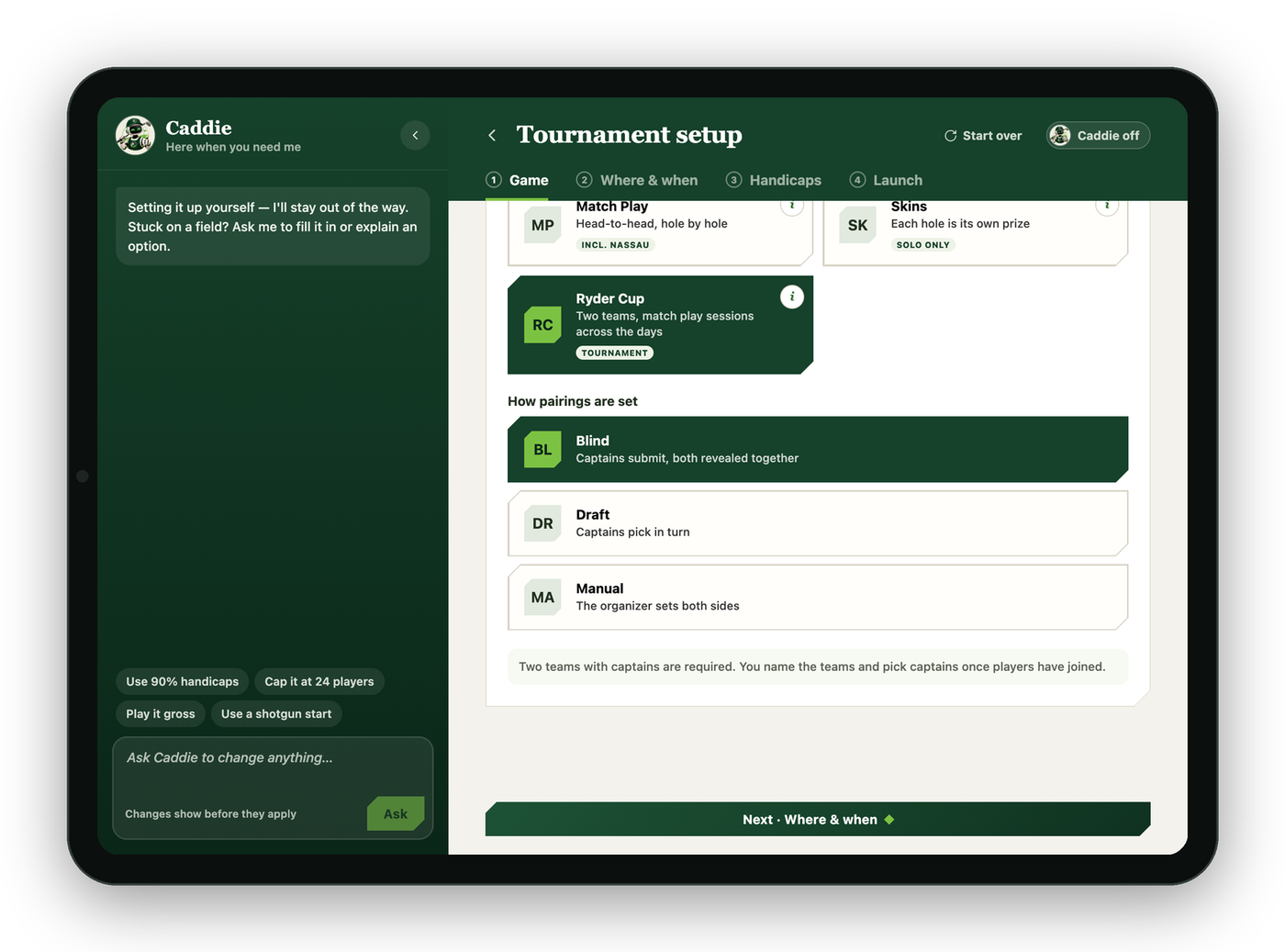
How pairings are set gives you three choices:
- Blind: captains submit their pairings, and both are revealed together.
- Draft: captains pick their matchups in turn.
- Manual: the organizer sets both sides' pairings.
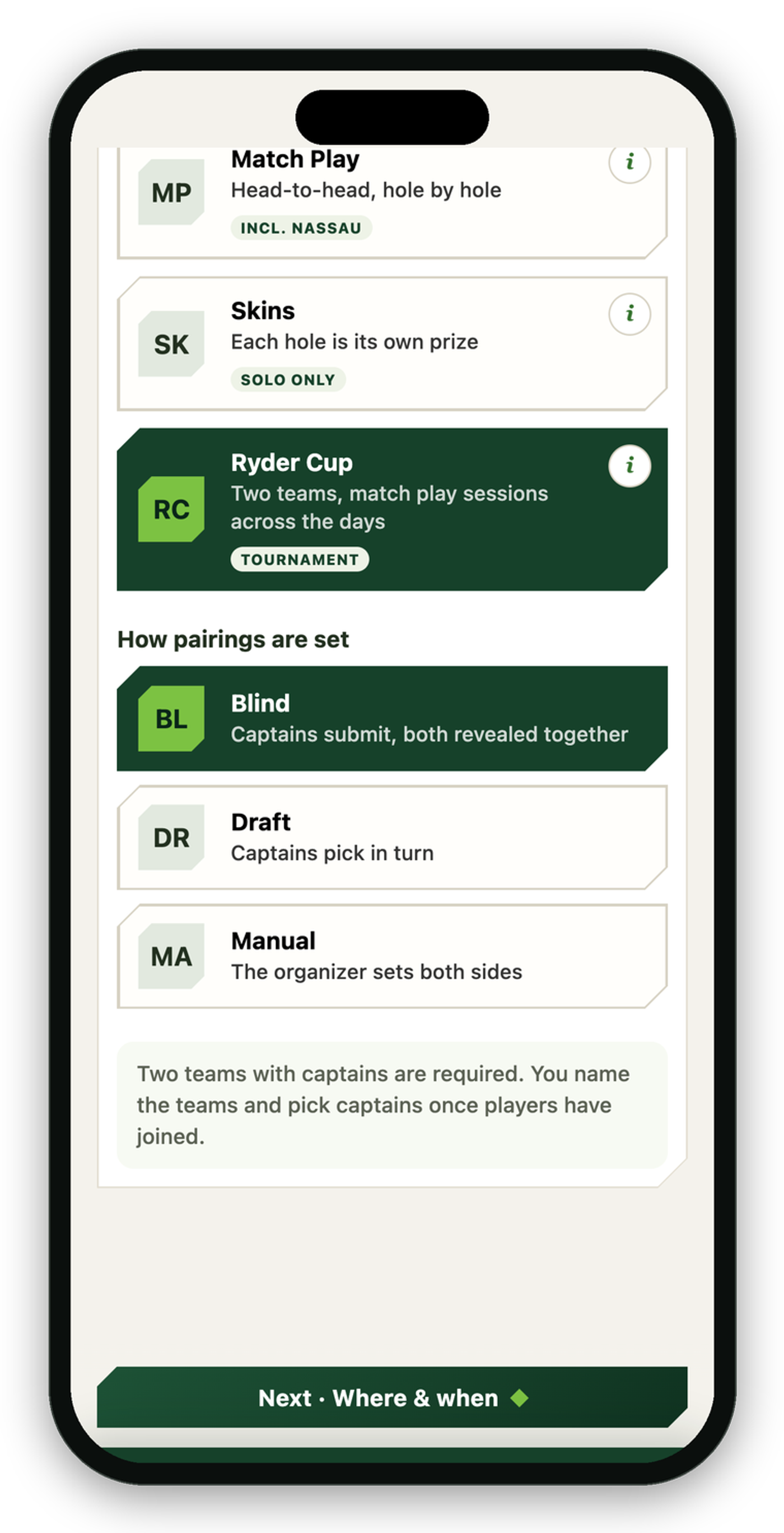
Once players join, you name the two teams and pick a captain for each. Captains can add players to their own side and set their own side's pairings, and that's all, so they can't touch the other team (or the rest of your settings). Each round can mix match types, so you can run a few four-ball matches, some alternate shot, a scramble session and singles, just like our day. Every match is scored hole by hole as it's played, and the standings show the two sides' points instead of a leaderboard, which is exactly how a Ryder Cup should look.
If your group keeps saying "we should do a Ryder Cup," this is your sign. Pick two captains, set the sessions, and let the trash talk start.
For the whole setup, screen by screen, see creating a league or tournament. Format and scoring options explained covers every Ryder Cup setting, and the features page shows everything else the app does.
Ryder Cup FAQ
The Ryder Cup format is a team match play competition between two sides. Players compete in head-to-head matches, each worth one point (half each for a tie), and the side with the most points wins.
In four-ball, each player on a two-person team plays their own ball and the better score on each hole counts. In foursomes, also called alternate shot, the two partners share one ball and take turns hitting it.
At the real Ryder Cup there are 28 points available and a team needs 14.5 to win outright. For your own event, just add up the matches. The side with more points wins, and you can decide in advance how to settle a tie.
The USGA recommends 100% of the handicap difference for singles, 90% for four-ball match play, and 50% of the combined team handicap for foursomes.
Any even number that makes groups of four works best, so 8, 12, 16, 24 or 40. Two-person teams need multiples of four to fill every match.
Yes. It's not part of the official Ryder Cup, but a two-man scramble session is a great way to start a league Ryder Cup, especially for players new to match play.
 Formats
Golf League Points System: How FedEx-Style Season Points Work
Rank the field every week and hand out points by finish, so one bad round never sinks your season. Here's how a golf league points system works, a points table that works, ties, teams, and how to set it up.
 Formats
Blind Draw Golf Format: How a Mystery Partner League Night Works
You play your round, then find out who your partner was. Here's how a blind draw works, how scores get combined, how to keep season standings fair with random partners, and how to set one up.
 Formats
We Ran a Ryder Cup Format Event and It Ended in a Tie
Our league finally ran a real Ryder Cup format event this fall, scramble, better ball, and singles all in one round. Forty guys, ten foursomes, and it came down to the last match. Here's what it actually took to run, and what almost went sideways.