
Format & Scoring Options Explained
Every event picks one format, but each format has real depth underneath it. This guide goes through every setting, format by format, so you know exactly what each one does before you pick it. If you're still deciding which format fits your group, start with Creating a League or Tournament — this guide is the reference for once you're in the Format & Scoring step and want to know what a specific setting actually changes.
Settings every format shares
These apply no matter which format you pick, in the Format & Scoring step of the builder (or later, in an event's Settings dialog).
Net, gross, or both. Net subtracts each player's handicap allowance from their score. Gross is the raw score, no adjustment. You can run net only, gross only, or both side by side — two parallel competitions from the same rounds, useful when your group has a wide handicap spread and you want a gross leaderboard for the low-handicap players too.
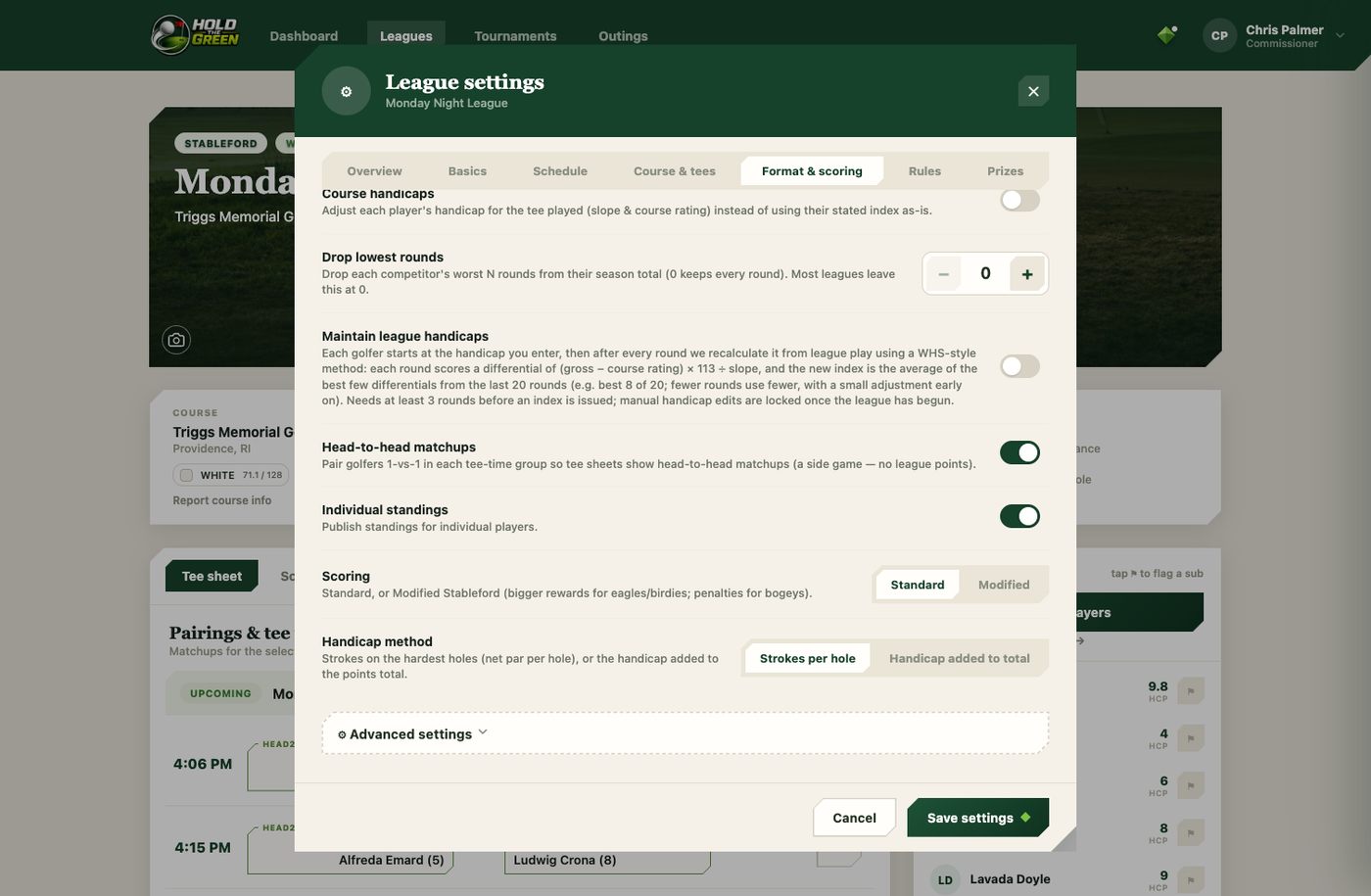
Course handicaps. Adjusts each player's handicap for the tee they actually played — using that tee's slope rating and course rating — instead of using their stated index as-is. Turn this on if your group ever plays from different tees in the same round; it's what keeps a mixed-tee group scored fairly. Leave it off and everyone's stated index is used directly.
Maintain league handicaps. Each golfer starts at the handicap you enter, then after every round it's recalculated automatically from actual league play, using a WHS-style method: each round scores a differential of (gross score − course rating) × 113 ÷ slope, and the new index is the average of the best few of those differentials from the last 20 rounds (best 8 of 20 once you have enough rounds; fewer rounds use fewer, with a small adjustment early in the season). It takes at least 3 rounds before a real index gets issued. Once the league has begun, manual handicap edits lock — the number is coming from actual play from that point on, not from you typing a new one in.
Drop lowest rounds. Optionally drops each competitor's worst N rounds from their season total (0 keeps every round, which is what most leagues run). Set it to individuals, teams, or both. It's the setting that keeps one bad night from quietly ending someone's season in week four.
Individual standings. A toggle for whether individual-player standings get published at all — some team leagues only want a team leaderboard and don't care about individual rankings underneath it.
Grouping. Whether the event is played individually, in 2-person teams, or in 4-person teams. This unlocks the team-specific settings below when you pick a team size.
Team scoring style (team formats only). How a team's score for the hole gets decided: best ball (take the best individual score on the team), scramble (everyone hits from the best shot each time), alternate shot (partners alternate hitting the same ball), or aggregate (add every teammate's score together).
Head-to-head matchups / 2-vs-2 match points (team formats only). Pairs golfers 1-vs-1 within each tee-time group so tee sheets show a head-to-head matchup as a side game. Turn it into real points and the winning side in each group earns match points (split on a tie), turning the season standings into a win-loss-halve race instead of a cumulative total. Set the points per matchup to whatever you like. This works for 2-person teams directly, and for 4-person teams that split into rotating pairs each week.
Stroke Play
The default format — lowest total score wins, individual or team, net or gross. Beyond the shared settings above, Stroke Play has its own standings option:
Standings mode. Either a straight cumulative total (add up every round's score across the season), or FedEx-style position points — instead of summing raw scores, each round awards points based on where a player finishes that round, and the season champion is whoever accumulates the most points. The points table (1st place gets X points, 2nd gets Y, and so on) is fully editable.
Team-driven individual races. When you're running a team format but still want individual bragging rights, this splits a team's season points among its members so a single individual champion emerges from what was otherwise team-only scoring.
Blind Draw pairing (team formats only). An indoor-league favorite, available as a pairing mode within Stroke Play rather than its own format. Each round you're randomly paired with a partner nobody can see — not even the organizer, if you choose — until the round closes and the draw is revealed, with a themed alias (a pseudonym style you pick) standing in for real names until then. It automatically uses position-points standings, since a shifting-partner format can't sum into one running team total the normal way. Team results feed a season-long points race that crowns a single champion through the ever-changing partnerships.
Stableford & Modified Stableford
Stableford scores points per hole against par instead of counting strokes, so one blow-up hole costs you points on that hole and nothing more — it doesn't wreck the rest of your card the way stroke play can.
Standard vs. Modified. Standard uses the normal Stableford point table. Modified Stableford swaps in a table that rewards aggressive play harder — bigger point jumps for eagles and birdies, and real penalties for bogeys — so it favors players willing to take on risk instead of just playing safe for pars. The Modified table is fully editable if you want to tune the rewards yourself.
Handicap method. Two ways your handicap strokes get applied: strokes on the hardest holes (a net-par-per-hole calculation — you get a stroke, sometimes two, on the holes your handicap allocates them to, and your points are scored against your net par on each) or handicap added to the total (play scratch, hole by hole, then add your full handicap allowance to the final points total once). The first rewards steady play on your stroke holes specifically; the second is simpler math with the same overall effect on your final score.
Match Play & Nassau
Head-to-head, solo or in teams — every hole is its own contest, won outright by whoever posts the lower score, until one side is up by more holes than remain (recorded the traditional way, e.g. "3 & 2").
Single match vs. Nassau. Play one match for the whole round, or a Nassau — front nine, back nine, and the overall round are scored as three separate matches, each worth its own point. A Nassau is popular specifically because it gives a player who's down early a fresh match at the turn.
Standings. Tracked as a win-loss-halve record with match points, not a stroke or points total — the season leaderboard is a record, the same way it would be at your home club.
Skins
Every hole is its own separate prize. Whoever posts the outright lowest score on a hole wins that hole's skin; if two or more players tie for low, nobody wins it and the skin carries over to the next hole, so pots can build across several holes before someone finally takes them.
Skin value. A free-form dollar amount per skin — set it to whatever your group is actually playing for.
Carryover. Toggles whether tied holes roll their value into the next hole (the traditional way skins games build drama) or whether a tied hole is simply skipped with no skin awarded and no carryover.
Standings. Tracked two ways: skins won (the count) and total earnings (skins won × skin value), so both the bragging-rights number and the money number are visible.
Ryder Cup
A purpose-built format for two-side team competition — your club against another, or any two sides you want to pit against each other — modeled on the real Ryder Cup rather than being a workaround bolted onto Match Play.
Two sides. The event's two teams face off across the whole event; there's no individual leaderboard, because the format was never a leaderboard to begin with.
Segments. Each round is built from Fourball, Alternate Shot, and Singles matches, and you can mix match types within a single day (a 6/6/6 day — six Fourball matches, six Alternate Shot, six Singles — is one tap away) or keep one match type per round if you'd rather spread them across multiple days.
Captain-scoped pairings. Each side's captain manages their own team's pairings round by round, the same way real Ryder Cup captains set their lineup — you're not exposing the other side's pairing strategy to your own captain, or vice versa.
Standings. A dedicated two-side match-point race. Each match played (Fourball, Alternate Shot, or Singles) is worth a match point, the two sides' points add up toward the majority needed to win, and that's the entire scoreboard — just like the real thing.
Nothing here fits your group?
If none of the above covers a rule your group actually plays by, there's a "Request a custom format" link right in the Format & Scoring step — describe what you need and it goes straight to our team.