


Golf League Points System: How FedEx-Style Season Points Work
Short answer: A season points system (FedEx Cup style) ranks every player each round and awards points by finishing place, for example 500 for first, 300 for second and 190 for third. Points add up across the season and the most points wins, so one bad round costs a few points instead of burying a season-long stroke total.
For years our league ran on a running total. Add up everybody's net score, every week, lowest total at the end of the season wins. Simple. Fair, sort of.
And then one year a guy missed three weeks for a family thing, came back, played great for the rest of the summer, and finished dead last. Meanwhile somebody else had one nightmare round in June (fine, it was me) and that one week sank my whole season before the Fourth of July.
That's when we switched to season points. It changed how the whole league feels. Here's how a points system works, why it's fairer than a running total, how to set up a points table, and how to run it.
What is a points-by-finish system in golf?
A points-by-finish system (you'll also hear FedEx-style points or season points) ranks everybody each round, then hands out points based on where you finished. First gets the most, second a little less, and so on. Points add up across the season, and the most points wins.
It's the same idea the PGA Tour uses for the FedEx Cup. Nobody cares if you won a tournament by one shot or by ten. You won, you get the winner's points.
Running total vs. points: why points are fairer
With a running total of strokes, every stroke you ever take is still on the board in September. One blow-up round can bury you, and a missed week leaves a hole in your total that's really hard to fix.
With points, a bad week only costs you that week's points. Finishing 14th instead of 4th hurts, but it's not a disaster you carry all year. And the guy who catches fire in August can actually climb, because winning a week is worth a lot.
I spent a few years as a 27 to 29 handicap and finally got down to a 22 this season. With a running total, guys like me were basically out of it the first time we had a rough night. With points, there's always next week.
How a points table works
You need a table that says how many points each finishing place gets. The FedEx Cup style table puts most of the points at the top. A common league version, scaled down for the top ten:
| Finish | Points |
|---|---|
| 1st | 500 |
| 2nd | 300 |
| 3rd | 190 |
| 4th | 135 |
| 5th | 110 |
| 6th | 100 |
| 7th | 90 |
| 8th | 85 |
| 9th | 80 |
| 10th | 75 |
Look at the gap between 1st and 2nd. Winning a week is a big deal, which keeps everybody grinding for the top spot instead of settling. If your league is bigger, you can stretch the table past ten places so more people score every week. If it's smaller and you want it flatter, shrink the gaps.
Ties get split. If two players tie for 1st, they each get the average of the 1st and 2nd place points, and the next player is 3rd. Same as the FedEx Cup.

Net or gross points?
You still need a score to rank everybody each week. Most leagues rank on net, so a 22 handicap and a 4 handicap are fighting for the same points. If you want a separate race for the scratch guys, run a gross version too.
The round itself is still plain stroke play: count every stroke, take off your handicap. The USGA covers that in Rule 3.3 of the Rules of Golf, and its recommended handicap allowances (Appendix C) put individual stroke play at 95%. In our league, about 80% has kept it the most even from the 30s down to single digits, which matters even more when points are on the line.
Points for teams, and for random partners
Points work for teams too: rank the teams each week and hand out the points. And there's a neat trick for when partners change every week: rank the teams, then split each team's points between its players. That turns a bunch of changing partnerships into one individual race. It's exactly how a blind draw league can still crown one champion.
Tips for running a points league
- Post the table before the season. Nobody should be surprised by what 3rd place is worth.
- Decide on missed weeks. Zero points is the simple answer, and dropping each player's worst round or two takes the sting out.
- Think about a finale. Some leagues double the points for the last week, just like the Tour's playoffs. Totally optional, very dramatic.
- Show the standings every week. A points race is only fun if you can see where you are.
Points vs. Stableford (they're different!)
People mix these up. Stableford gives you points on every hole based on your score. Points by finish gives you points for where you finished the round compared to everybody else. Stableford is a way to score a round. Points by finish is a way to keep season standings.
How to set up season points in Hold the Green
Season points live on the Handicaps step of the event builder, under Standings. Set up a Stroke Play league or tournament as usual, then:
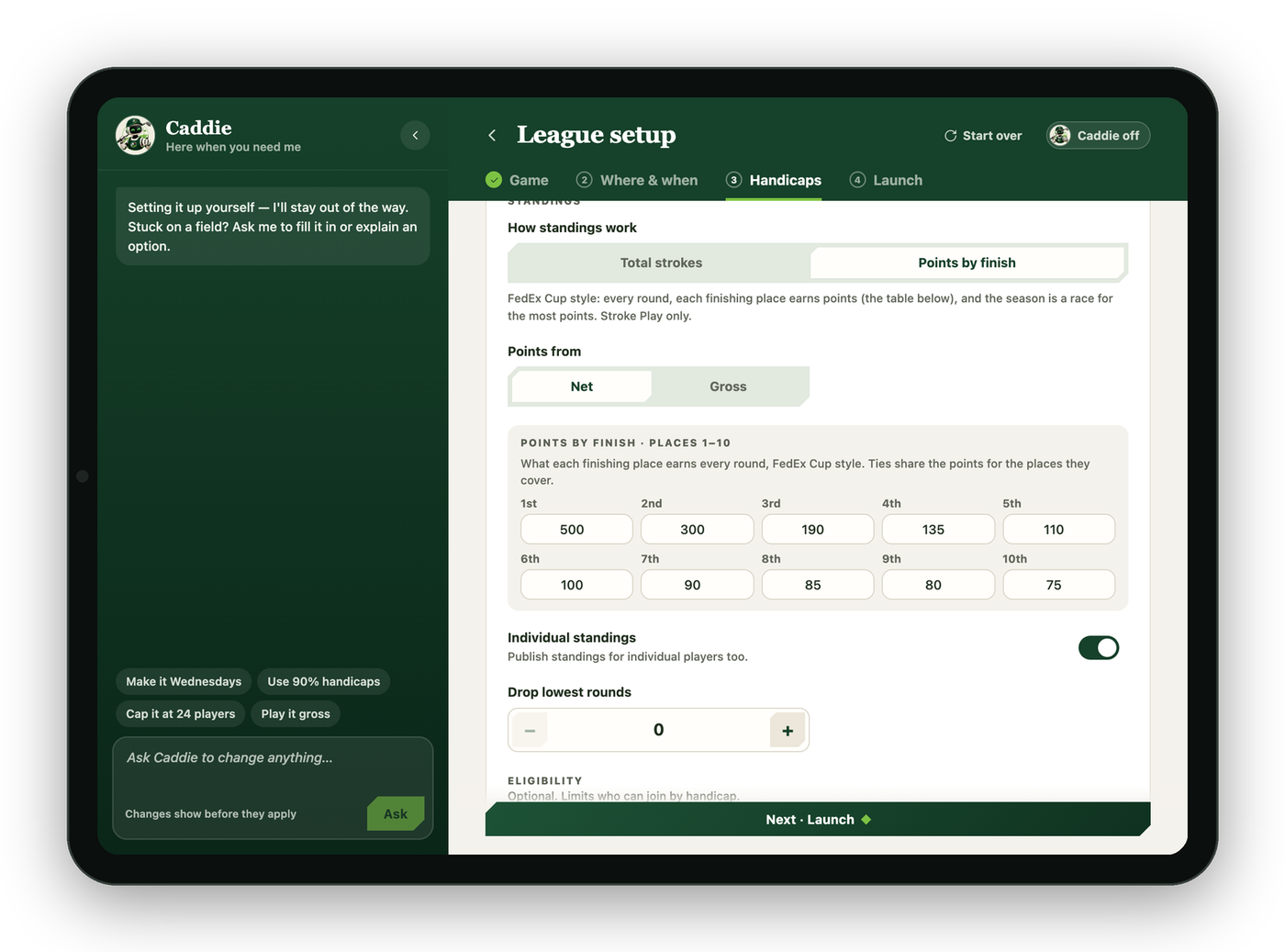
- Under How standings work, switch from Total strokes to Points by finish. (It's a stroke play option, FedEx Cup style.)
- Under Points from, pick Net or Gross.
- Edit the points by finish table for places 1 through 10. It starts with the FedEx Cup style numbers above (500, 300, 190 and so on), and you can change any of them. Places past the table get zero.
- Turn on Individual standings if you want a player board, and set Drop lowest rounds if you want each player's worst weeks thrown out.
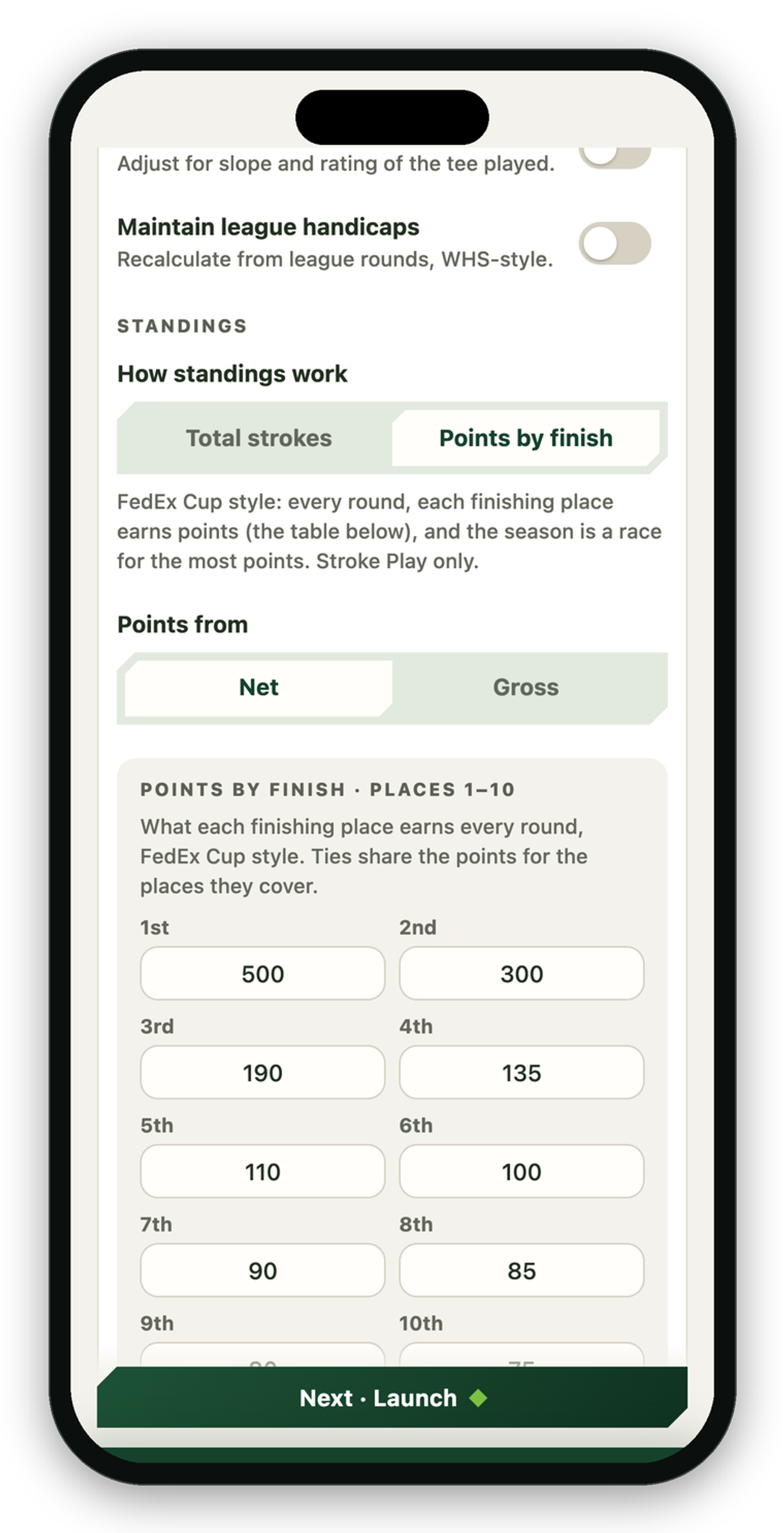
Every closed round gets ranked, ties split the points, and the season standings add up as you go. Each round's leaderboard still shows strokes, so you can see exactly how you earned your points.
Season points turned our league from "who had the fewest bad nights" into a real race every week. And if you'd rather not rank the field and add up points in a spreadsheet, Hold the Green does it as soon as each round closes.
For the whole setup, screen by screen, see creating a league or tournament. Format and scoring options explained covers every season points setting, and the features page shows everything else the app does.
Season points FAQ
It's a season standings system where players are ranked each round and earn points based on where they finish. Points add up over the season, and the player with the most points wins, just like the FedEx Cup on the PGA Tour.
After each round, everyone is ranked by score (usually net), and each finishing place earns a set number of points from a table. The points are added up across the season.
A common choice is the FedEx Cup style top-ten table: 500, 300, 190, 135, 110, 100, 90, 85, 80 and 75. Bigger leagues can stretch it past ten places, and smaller ones can flatten the gaps.
Tied players split the points for the places they cover. Two players tied for 1st each get the average of the 1st and 2nd place points, and the next player is 3rd.
For most leagues, yes. A bad round or a missed week only costs you that week's points instead of sinking your whole season, which keeps more people in the race.
 Formats
Blind Draw Golf Format: How a Mystery Partner League Night Works
You play your round, then find out who your partner was. Here's how a blind draw works, how scores get combined, how to keep season standings fair with random partners, and how to set one up.
 Formats
Ryder Cup Format Explained: Four-Ball, Foursomes, Singles and How to Run One
Two sides, head-to-head matches, a point for every win. Here's how the Ryder Cup format works, the difference between four-ball and foursomes, handicaps for each match, and how to run one for your own group.
 Formats
We Ran a Ryder Cup Format Event and It Ended in a Tie
Our league finally ran a real Ryder Cup format event this fall, scramble, better ball, and singles all in one round. Forty guys, ten foursomes, and it came down to the last match. Here's what it actually took to run, and what almost went sideways.