


What Is Stableford in Golf? Points, How to Play, and the Modified Version
Short answer: Stableford scores points on each hole instead of counting strokes: 0 for double bogey or worse, 1 for bogey, 2 for par, 3 for birdie, 4 for eagle and 5 for albatross. The highest total wins. Played net, handicap strokes come off each hole first, so one blow-up hole costs you a zero, not your round.
Every round I play has one hole that tries to end it. Usually it's early. Usually there's water involved. And in regular stroke play, that hole follows me around all night like a bad smell, because a 9 is a 9 and it's going on the card no matter what.
Stableford is the format that looks at my 9 and says, "Eh, that's a zero. Go hit your next tee shot."
I love it. Here's what Stableford is, how the points work, how to play it net, the handicap allowance I've found works best, and the Modified version that turns the whole night into a birdie hunt.
What is Stableford in golf?
Stableford is a scoring format where you earn points on each hole based on your score compared to par, instead of counting total strokes. More points is better, and the highest total wins.
It's officially part of the Rules of Golf. The USGA covers it in Rule 21.1 of the Rules of Golf, where points are awarded by comparing your score on each hole to a fixed target, which is par unless the committee sets something else.
Stableford points: the scoring table
The standard Stableford points go like this:
| Score on the hole | Points |
|---|---|
| Double bogey or worse | 0 points |
| Bogey | 1 point |
| Par | 2 points |
| Birdie | 3 points |
| Eagle | 4 points |
| Albatross | 5 points |
Look at the top of that table. A double bogey and a quadruple bogey both get you zero. There's no negative. Once you've blown a hole, you can pick up your ball and move on. Your round isn't over. It's just one hole.
How to play Stableford
- Play each hole like normal.
- Compare your score (or your net score, if you're playing with handicaps) to par.
- Write down the points from the table.
- If you can't score a point anymore, pick up and walk to the next tee.
- Add up your points at the end. Most points wins.
A good benchmark: 2 points a hole is net par, so 36 points over 18 holes (18 over 9) means you played exactly to your handicap. Anything above that is a really good day.
Why Stableford is the best format for high handicappers
I was a 27 to 29 handicap for a few years and only got down to 22 this season. My scorecard on a normal night looks like a heart monitor. A couple of pars, a bunch of bogeys and doubles, and one hole where things went sideways.
In stroke play, that sideways hole is a disaster. In Stableford it costs me two points at most compared to a bogey. That changes how the whole night feels.
There was a night last summer where I had a nightmare on the 2nd hole. Lost a ball, found it, hit it into a bush, the whole show. In stroke play I'd have been mentally done before the 3rd tee. In Stableford I picked it up, wrote down a zero, and had one of my better nights of the year. My buddies still say I sandbagged that round. I maintain it was the format.
It's great for pace, too. If you can't score on a hole, you pick up. No more waiting on somebody grinding over an 11-footer for a triple.

Playing Stableford net (with handicaps)
Most leagues play Stableford net. Your handicap strokes come off your score on the holes you get them on, and then you figure your points from that.
Say I get a stroke on a par 4 and make a 5. That's a net par, so I get 2 points instead of 1. On the hardest holes a high handicapper might get two strokes, so a 6 on a par 4 is still a net par. That's why Stableford is so friendly to players like me. A solid bogey hole turns into real points. Which holes you get strokes on comes from the stroke index row on the card, explained in the USGA's Appendix E.
The handicap allowance I've found works best
The USGA's recommended allowances (Appendix C) are 95% for individual Stableford and 85% for four-ball Stableford, where two partners each play their own ball and the better points score counts.
But here's what I've seen in my own league. 80% produces the most level playing field, from guys around 30 all the way down to single digits. Go much above 80% and the high handicaps run away with it. I know, because as a 27 to 29 I was one of the guys running away with it some weeks, and it didn't feel totally fair. Go much below 80% and the high handicaps just don't have a chance to score against the low ones. 80 is a nice sweet spot. Try it for a few weeks and see where your results land.
Strokes per hole vs. points added at the end
Some leagues don't hand out strokes hole by hole. They score gross points, then add a set number of bonus points at the end based on handicap. It's simpler to explain, but it's not quite the same. Per-hole strokes reward you for playing the hard holes well, and that's usually the fairer choice. Pick one and tell everybody.
Modified Stableford (a.k.a. the birdie hunt)
If regular Stableford is the friendly version, Modified Stableford is the one that wants you to go for the green over the water. The points change, and now there are negatives. One common Modified table:
| Score on the hole | Points |
|---|---|
| Double bogey or worse | minus 3 points |
| Bogey | minus 1 point |
| Par | 0 points |
| Birdie | 2 points |
| Eagle | 5 points |
| Albatross | 8 points |
Par gets you nothing. Birdies and eagles are where the points live, and bad holes hurt again. It's a blast for better players, or for a special night where you want people taking chances. For a high handicap league I'd stick with standard most weeks. Ask me how I know.
How to set up Stableford in Hold the Green
In the event builder, pick League or Tournament, then Start fresh. On the Game step, choose Stableford:
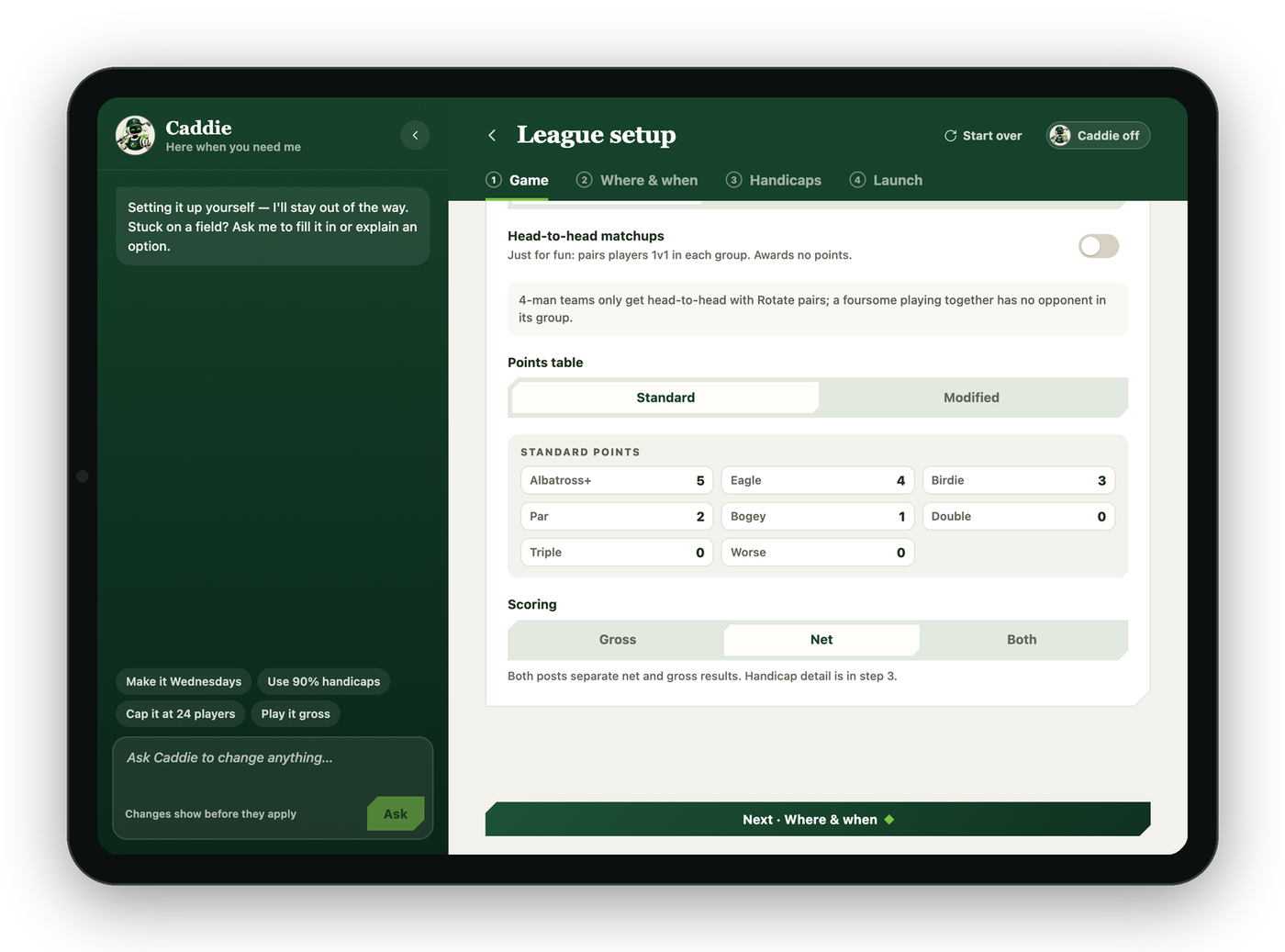
- Points table: Standard or Modified, with the points for every score shown right there so nobody has to guess.
- Grouping: Solo, 2-man or 4-man. Teams work great, adding the better points score on each hole, a little like best ball with points.
- Head-to-head matchups for a little extra on the side.
- Scoring: Gross, Net or Both.
Then on the Handicaps step:
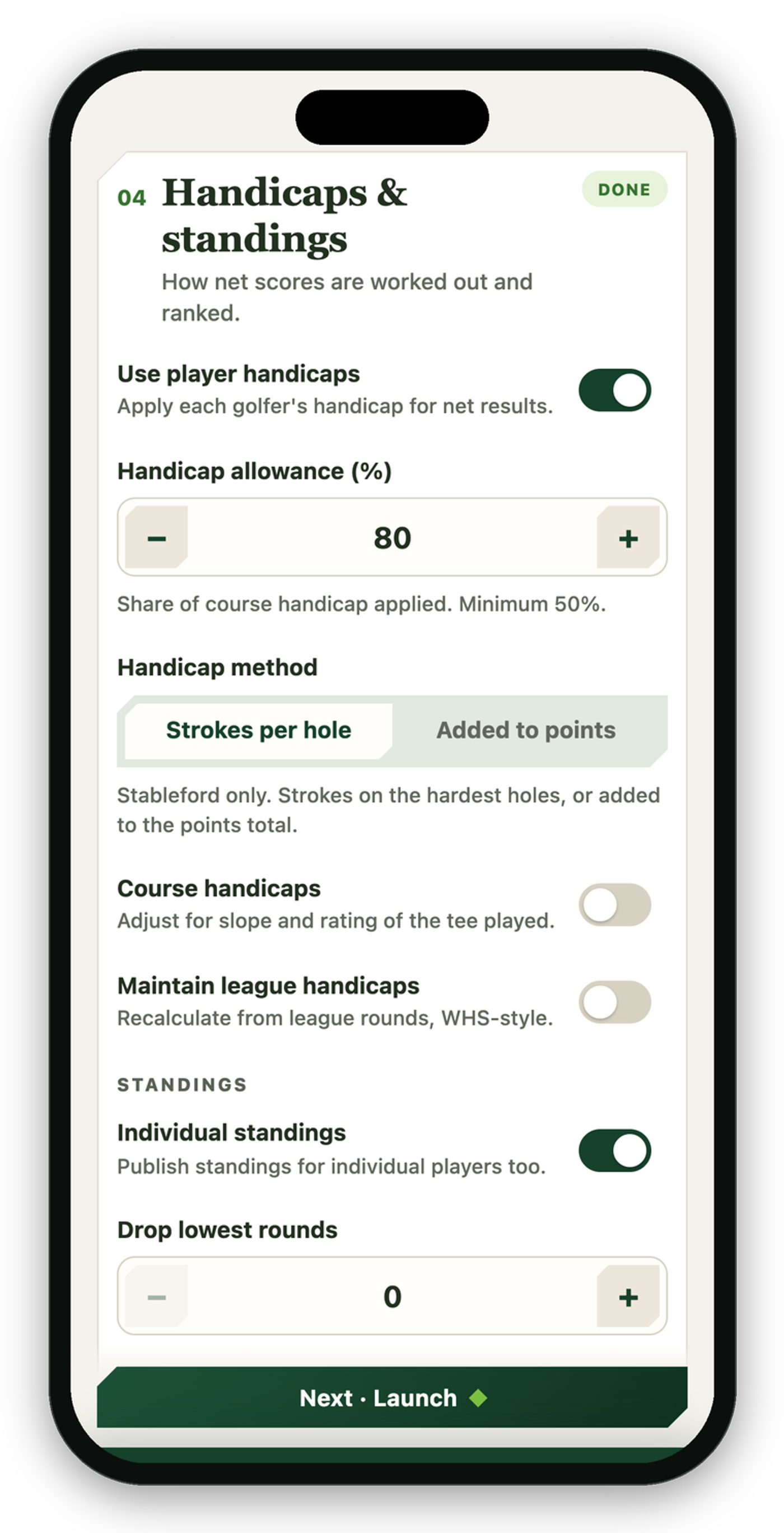
- Handicap allowance (%): where you'd set my 80%.
- Handicap method: Strokes per hole (strokes on the hardest holes) or Added to points (gross points plus a bonus at the end).
- Course handicaps for players on different tees, and Maintain league handicaps if you want them recalculated from league rounds.
- Drop lowest rounds, so one bad week doesn't sink a season.
Season standings just add up points week to week. If you want a race that rewards where you finish each week instead, take a look at season points standings.
Stableford is the format that keeps your bad holes from becoming bad nights. And Hold the Green works out everybody's points as the scores go in, standard or modified, with the strokes on the right holes.
For the whole setup, screen by screen, see creating a league or tournament. Format and scoring options explained covers every Stableford setting, and the features page shows everything else the app does.
Stableford FAQ
Stableford is a format where you earn points on each hole based on your score compared to par: 0 for double bogey or worse, 1 for bogey, 2 for par, 3 for birdie, 4 for eagle and 5 for albatross. The highest total wins.
36 points over 18 holes (or 18 over 9) means you played exactly to your handicap. Anything higher is a very good round.
Not in standard Stableford. The worst you can score on a hole is zero. In Modified Stableford, bogeys and worse usually cost you points.
Standard Stableford never takes points away and rewards steady play. Modified Stableford gives par zero points, takes points away for bogeys and worse, and gives big points for birdies and eagles, so it rewards aggressive play.
The USGA recommends 95% for individual Stableford and 85% for four-ball Stableford. In a league with a wide spread of handicaps, around 80% often keeps it most even.
Yes. Once you can't score a point on a hole, you can pick up. It's one of the best things about the format for pace of play.
 Formats
Golf League Points System: How FedEx-Style Season Points Work
Rank the field every week and hand out points by finish, so one bad round never sinks your season. Here's how a golf league points system works, a points table that works, ties, teams, and how to set it up.
 Formats
Blind Draw Golf Format: How a Mystery Partner League Night Works
You play your round, then find out who your partner was. Here's how a blind draw works, how scores get combined, how to keep season standings fair with random partners, and how to set one up.
 Formats
Ryder Cup Format Explained: Four-Ball, Foursomes, Singles and How to Run One
Two sides, head-to-head matches, a point for every win. Here's how the Ryder Cup format works, the difference between four-ball and foursomes, handicaps for each match, and how to run one for your own group.