


What Is Stroke Play in Golf? Rules, Net vs. Gross, and How to Run It
Short answer: Stroke play is golf’s standard format: you count every stroke over the round, penalty strokes included, and the lowest total wins. In a handicap event, each player’s course handicap comes off their gross score and the lowest net total wins. Stableford, skins and best ball are all built on stroke play scores.
Stroke play is the most honest game in golf. And honestly? That's what makes it a little terrifying.
Every swing counts. The drive you pured down the middle counts. The chunked wedge that went eleven feet counts. The putt you missed from two feet because you were already thinking about the next tee? Yep. That one counts too, and it'll be sitting on the card for everyone to see.
It's also the format almost everything else in golf is built on. Stableford, skins and best ball are really just stroke play wearing a different hat. So if you run a league, or you're thinking about starting one, it's worth knowing the plain version inside out before you dress it up.
What is stroke play in golf?
Stroke play is the format where you count every stroke you take over the whole round, penalty strokes included, and the lowest total wins.
That's it. No points, no holes won or lost, no partner bailing you out. It's you against the course and everyone else in the field at the same time, even the guys three groups ahead who you never actually see.
If you want the official version, the USGA covers it in Rule 3.3 of the Rules of Golf. The player with the fewest total strokes wins, or the fewest net strokes in a handicap event.
Stroke play rules worth knowing
Most of the Rules of Golf are the same no matter what you're playing, but a few things are different in stroke play:
- You have to hole out on every hole. Nobody can concede you a putt, even a 6-incher. Tap it in.
- The general penalty is two strokes. In match play the same breach usually costs you the hole. In stroke play it's two shots on your card.
- Your score counts against the whole field. In match play you only care about one opponent. In stroke play, a 9 on one hole hurts you in the standings no matter what anyone else in your group made.
That last one is the big mental difference, and it's why a lot of players feel more pressure in stroke play.
Stroke play vs. match play
People mix these up all the time, so here's the quick version. In stroke play, you add up every stroke for the round and lowest total wins. In match play, you play hole by hole against one opponent, and whoever wins more holes wins the match. A blow-up hole in match play just loses you one hole. In stroke play it's on your total forever.
If you like the hole-by-hole thing, the Nassau is match play split into three separate matches, and it's a great league format too.
Gross vs. net (or: why the 25 handicap can still win)
Gross is the raw number, every stroke you actually took. Shoot 94 and your gross is 94.
Net is your gross minus your handicap strokes. Shoot 94 with a 20 handicap and your net is 74.
Most leagues play net, because a pure gross game means the same two players win every week and everyone else is basically paying to watch. One of our beta leagues told us their best night all season was a 28 handicap beating the club's best player by a stroke on net, and the guy who lost bought the first round without anybody asking. That's the whole point of handicaps right there.
Plenty of leagues pay out both, a gross winner and a net winner, so the strong players still have something to chase.

How much of your handicap should you play off?
First, your Handicap Index turns into a Course Handicap for the course and tees you're playing, using the slope and course rating. The USGA lays out the math in Rule 6.1 of the Rules of Handicapping.
Then a lot of events apply a handicap allowance, a percentage of that Course Handicap. For individual stroke play, the USGA's recommended handicap allowances (Appendix C) put it at 95%.
Here's a real-world take, though. Deryk, who built Hold the Green and runs his own league, has found that 80% produces the most level playing field, from players around 30 all the way down to single digits. He's lived both ends of it. He was a 27 to 29 handicap for a few years and only this season got it down to 22. In his league, anything much above 80% and the high handicappers tend to run away with it. Anything much below and they just don't have a chance against the lower handicaps. 80 has been the sweet spot.
Your league might land somewhere else, and that's fine. The point is to pick a number on purpose, watch who's winning for a few weeks, and adjust if one end of the field is running the table.
Surviving the blow-up hole
Everybody in the field has a hole that goes sideways eventually. Two in the water, a fat chip, three putts. Stroke play rewards the player who limits the damage, not the one who never makes a mistake (that person isn't in your league, trust us).
- Take your medicine. In the trees? Chip it back out sideways. Bogey is fine. The hero shot through a gap the size of a mailbox is how a 5 becomes an 8.
- Know your drop options. Penalty areas, unplayable lies, out of bounds. The right drop can save a stroke without breaking a single rule.
- Count honestly. In stroke play a missed stroke changes the standings for everyone. Leagues are relaxed about a lot of things. Not this.
If the blow-up hole is what keeps people from enjoying league night, that's exactly the problem Stableford solves.
How to set up stroke play in Hold the Green
This is the format most leagues start with, so it's the first one in the event builder. Pick League (or Tournament), then Start fresh if you'd rather set it up yourself than describe it to Caddie.
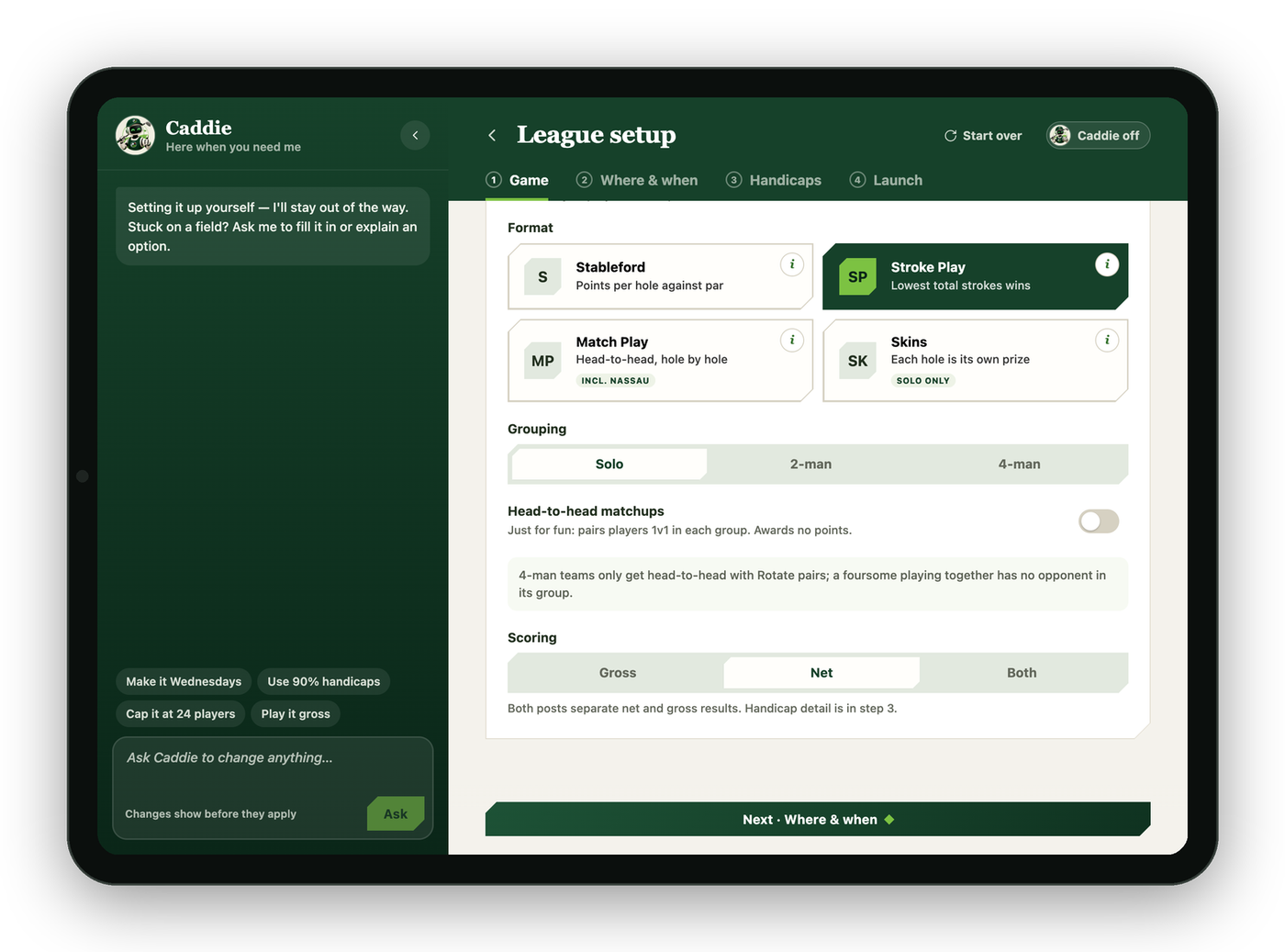
On the Game step, choose Stroke Play. Then you've got a few choices:
- Grouping: Solo for individual stroke play, or 2-man and 4-man for teams. Pick a team size and you'll get a Team scoring choice: aggregate (everyone's score adds up), best ball, scramble or alternate shot.
- Head-to-head matchups: an optional, just-for-fun 1v1 pairing inside each group.
- Scoring: Gross, Net, or Both. Both posts separate gross and net results.
The handicap side lives on the Handicaps step:
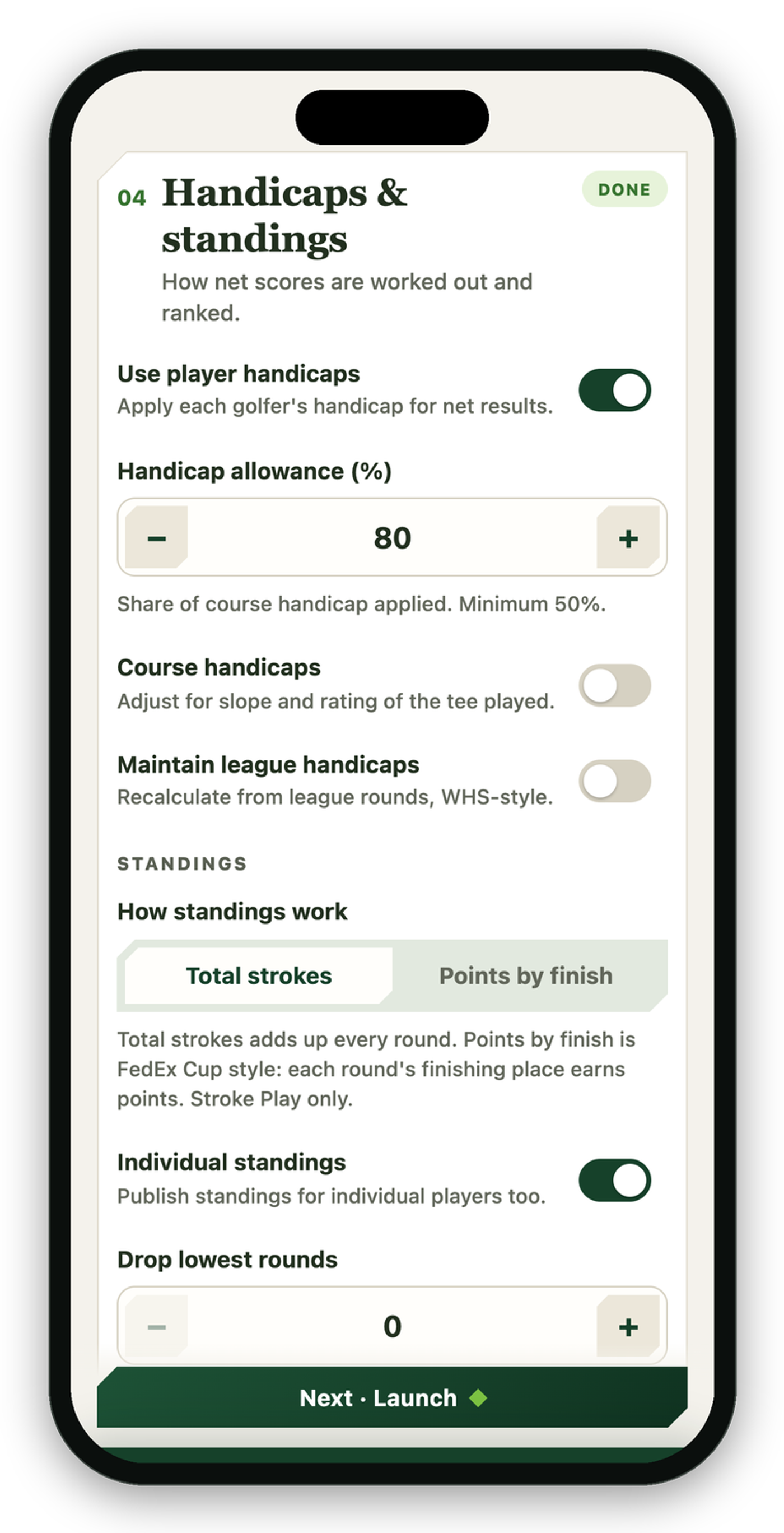
- Use player handicaps: on for net scoring.
- Handicap allowance (%): the share of each player's course handicap that's applied (anything from 50% up). This is where you'd set that 80%.
- Course handicaps: adjusts for the slope and rating of the tee each player is actually playing.
- Maintain league handicaps: recalculates handicaps from your league rounds, WHS-style.
- How standings work: Total strokes adds up every round. Points by finish awards points for where you finished each week instead, FedEx Cup style. We go deep on that one in our guide to season points standings.
- Drop lowest rounds, handicap eligibility limits, and what happens when someone misses a round (leave them out, or count their worst score).
Every setting can be changed after launch, so you're not locked into anything on week one.

Stroke play is the honest game. Set it up once, decide your allowance on purpose, and let the scores tell the story. If you'd rather skip the parking-lot math, Hold the Green will run it for you and keep the standings up to date as soon as the scores are in.
For the whole setup, screen by screen, see creating a league or tournament. Format and scoring options explained covers every stroke play setting, and the features page shows everything else the app does.
Stroke play FAQ
Stroke play is a golf format where you count every stroke you take over the round, including penalty strokes, and the player with the lowest total wins. In a handicap event, the lowest net score (gross minus handicap strokes) wins.
In stroke play your total score for the whole round counts against everyone in the field. In match play you play hole by hole against one opponent, and whoever wins more holes wins. A bad hole in match play only costs you that hole.
Yes. Under the Rules of Golf you have to hole out on every hole in stroke play, and nobody can concede a putt. Some casual leagues relax this to speed up play, but scores posted for handicap purposes should be holed out.
The USGA recommends 95% of Course Handicap for individual stroke play. In practice, a lot of leagues with a wide spread of handicaps find something around 80% keeps it most even. Pick a number, watch the results for a few weeks, and adjust.
Net, for most leagues, because it gives every player a real chance to win. If you have strong players who want something to chase, run both and pay a gross and a net winner.
Common ways are matching cards (comparing the back nine, then the last six, three and one holes), a sudden death playoff, or splitting the prize. Agree on one before the round starts.
 Formats
Golf League Points System: How FedEx-Style Season Points Work
Rank the field every week and hand out points by finish, so one bad round never sinks your season. Here's how a golf league points system works, a points table that works, ties, teams, and how to set it up.
 Formats
Blind Draw Golf Format: How a Mystery Partner League Night Works
You play your round, then find out who your partner was. Here's how a blind draw works, how scores get combined, how to keep season standings fair with random partners, and how to set one up.
 Formats
Ryder Cup Format Explained: Four-Ball, Foursomes, Singles and How to Run One
Two sides, head-to-head matches, a point for every win. Here's how the Ryder Cup format works, the difference between four-ball and foursomes, handicaps for each match, and how to run one for your own group.